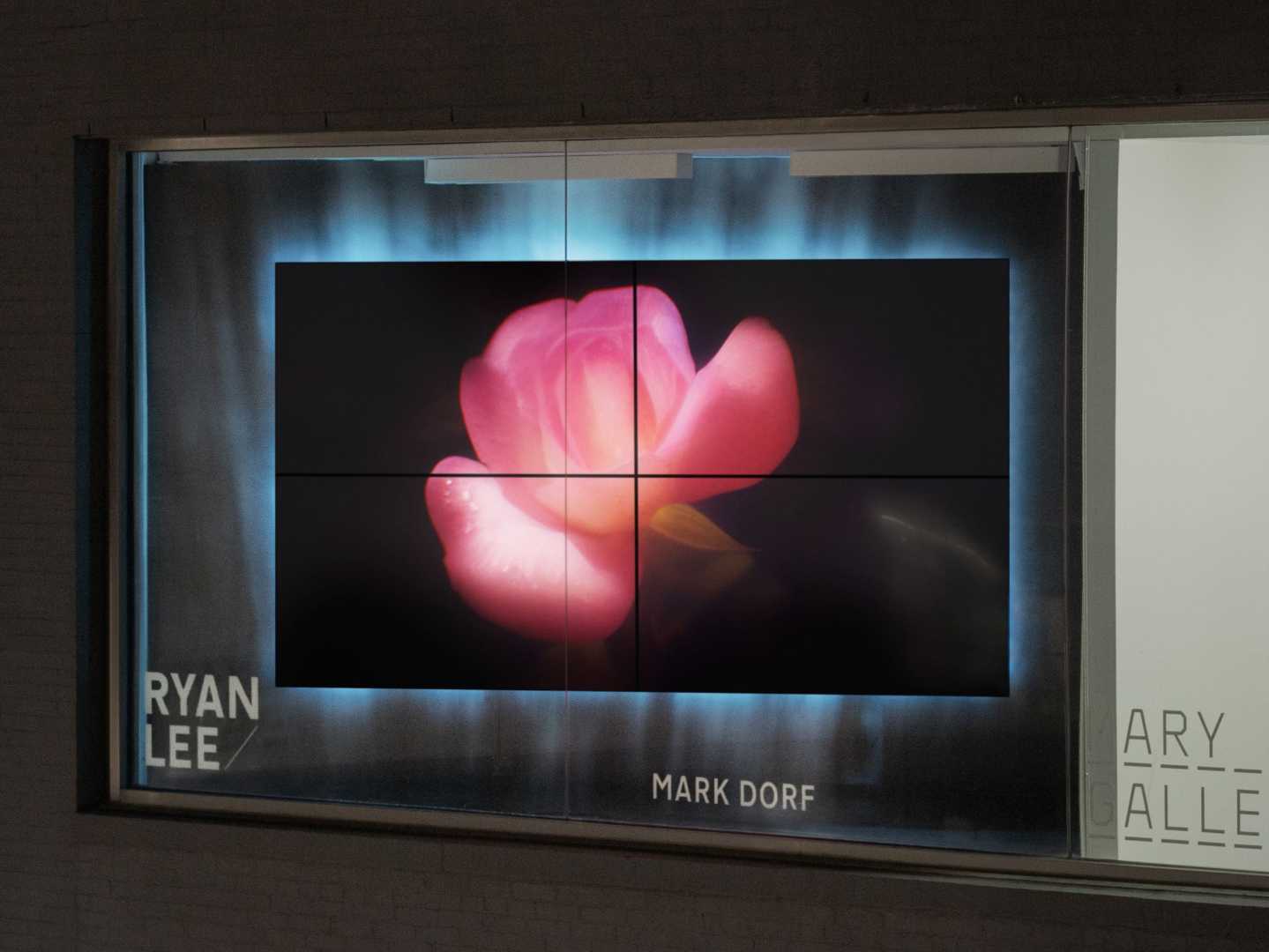
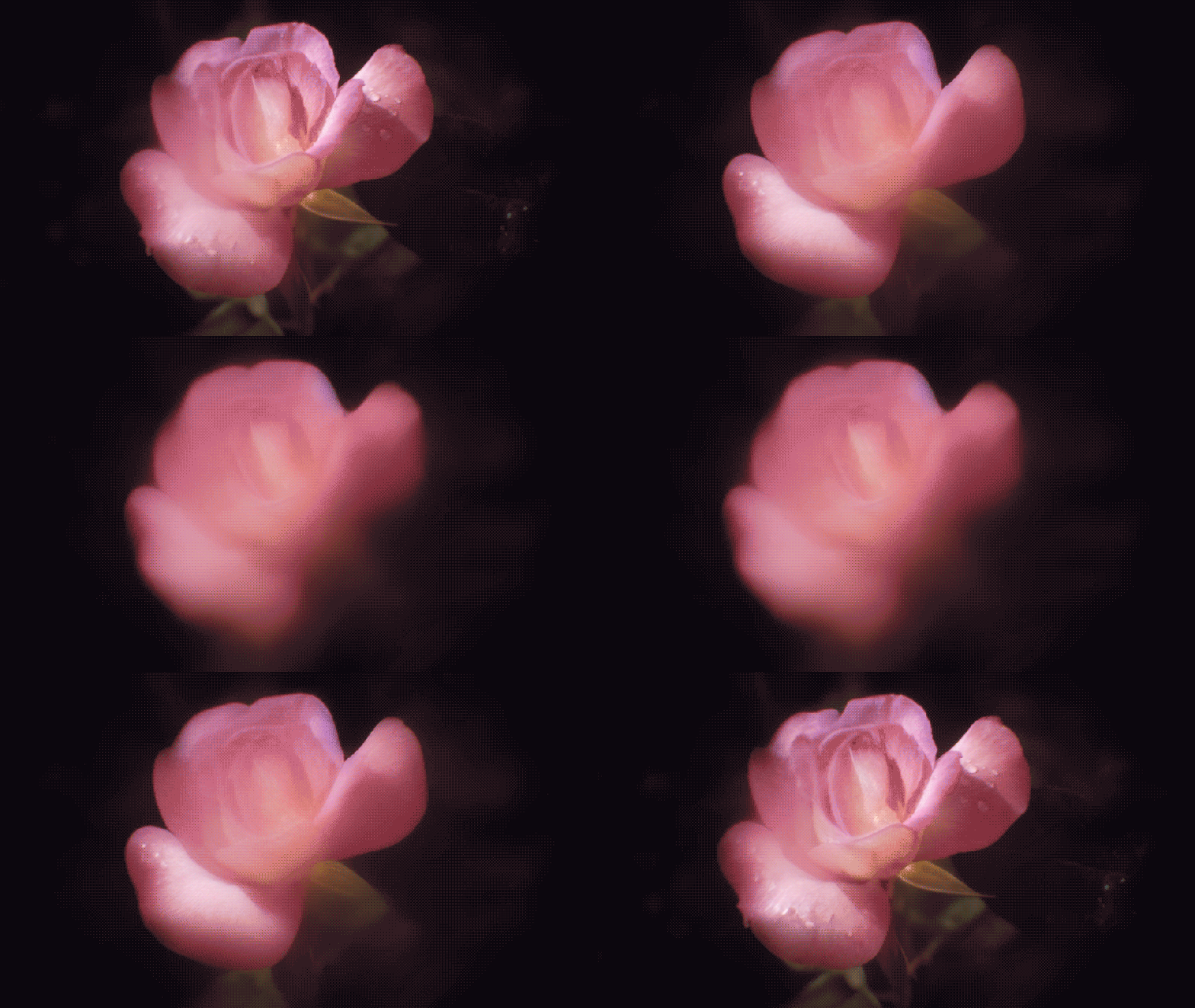
RYAN LEE Gallery is pleased to announce Origin of a Made Place, a video installation in RLWindow by Mark Dorf depicting roses shot at the Portland International Rose Test Garden that have been processed through “inverse diffusion,” a process that can be considered the reverse of traditional AI image generation.
Presented as a four channel video, the rose images in the video fluctuate between the noise from which the photograph could have emerged through AI image generation and the photograph that is its source. The wall vinyl portrays a Photo Response Non-Uniformity (PRNU) variance map, a forensic fingerprint of the specific camera sensor that made these images, a process often used in determining whether an image is AI generated or produced by a photosensitive sensor.
Roses are among the most genetically controlled species in human history. The Portland International Rose Test Garden came to be in 1917 when Portland, OR offered sanctuary for rose varieties endangered by World War I, its beginnings rooted in the imperial politics that determined which species were deemed cultural heritage worth saving. To this day, the garden is a testing ground for new hybridization, producing the bloated floral forms that define rose culture across the world. A similar structure is at work in contemporary AI image platforms. Just as roses have been bred into a cartoon-like version of themselves, image generation platforms create feedback loops of homogenized imagery in the name of socio-political ideologies, silently employing a public to create and distribute its image. A rose that an AI image generator produces is overdetermined three times: first by the centuries of hybridization that shaped the flower, next by every visual representation of that flower, and finally by the intentions of the platform generating its image.
The title is a reference to the 1960 poem “Often I Am Permitted to Return to a Meadow” by Robert Duncan. It is a poem about a place that is made in one’s unconscious, a place of perpetual return whose existence depends on an act of imagination, choice, perception, and memory. Origin of a Made Place takes on a similar tension, asking where images come from, and finding that like the meadow, and like the rose, the origin itself is a construction wielded by an author.
Mark Dorf
Origin of a Made Place, 2026
four panel 4k video (color), custom inverse-diffusion model, LED lighting, vinyl wall print; dimensions variable.
© Mark Dorf; Courtesy of the artist and RYAN LEE Gallery, New York.
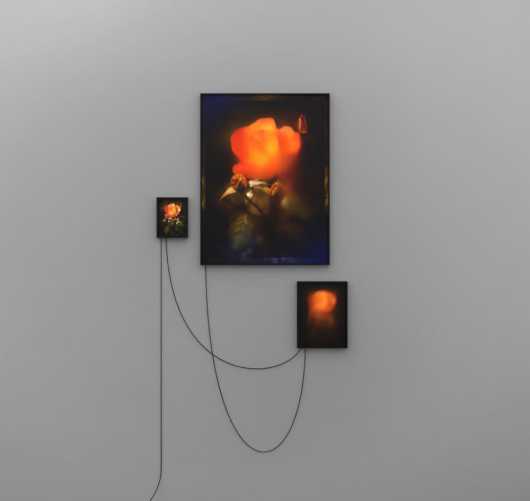
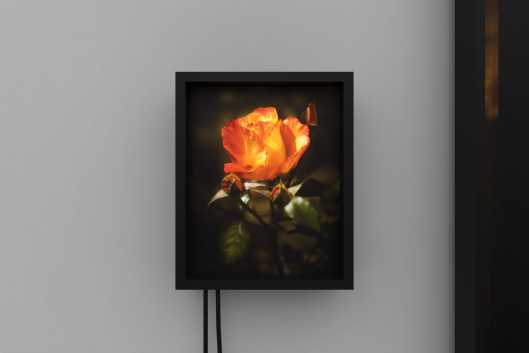
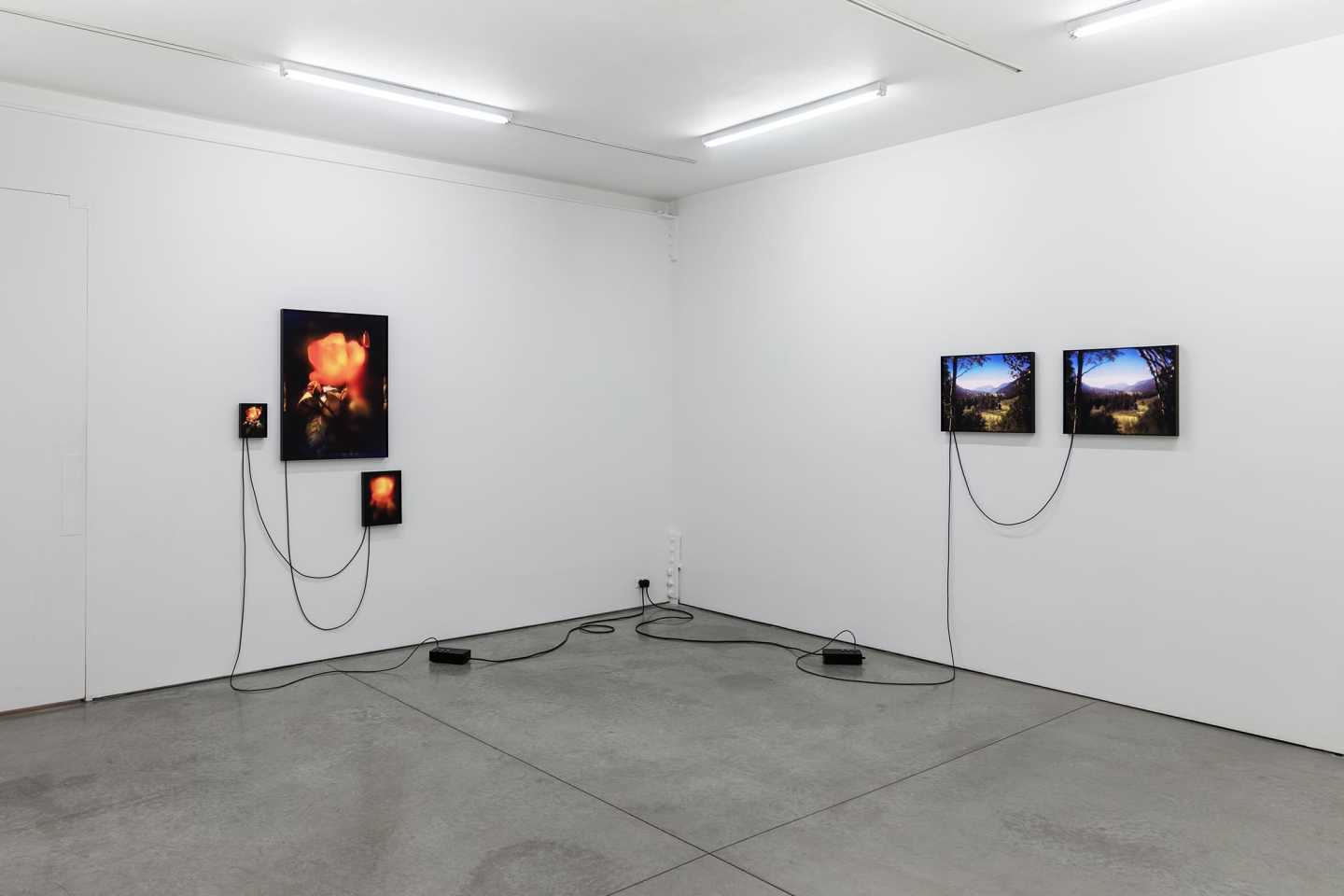
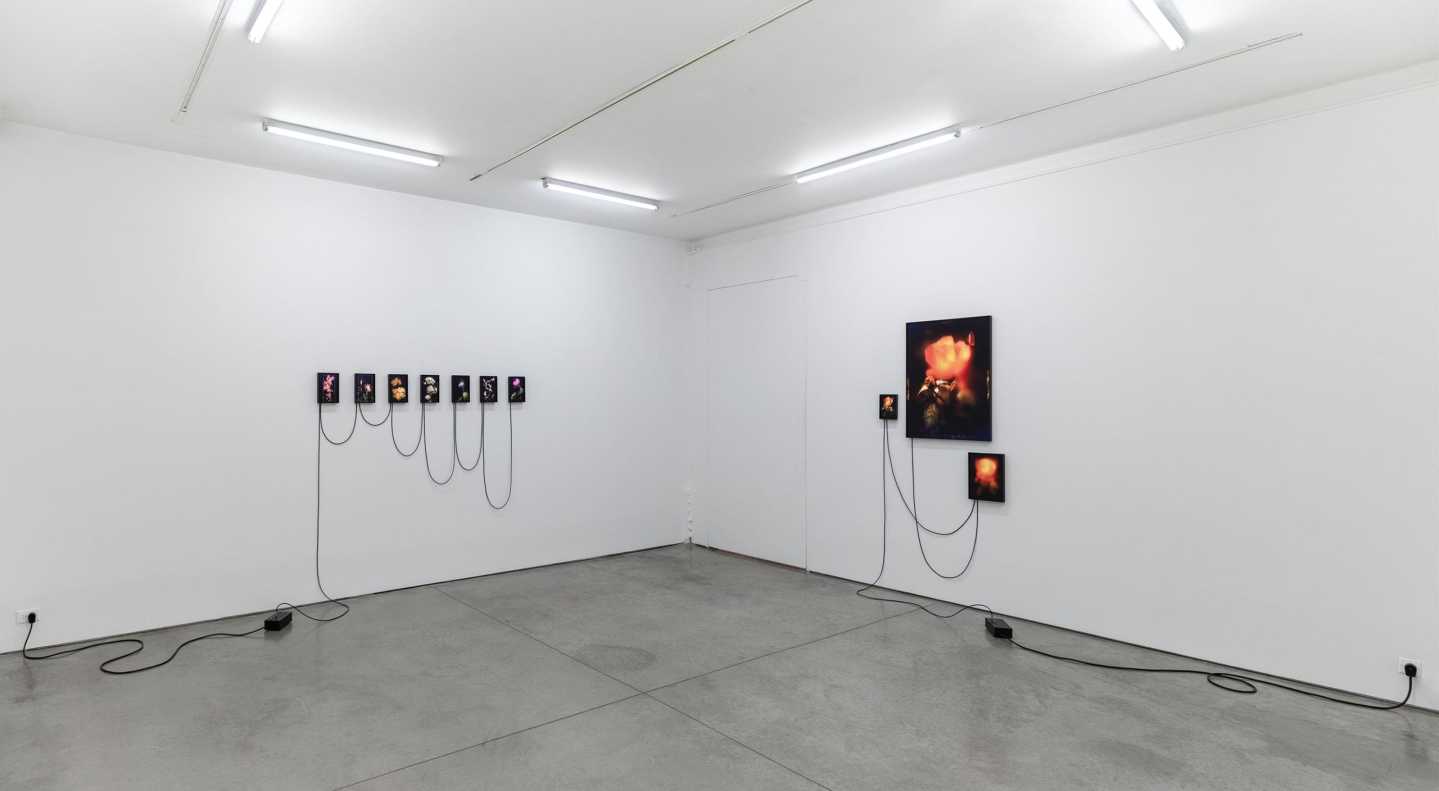
In Latent Image, three rear-illuminated panels, each image derived from the same photograph of a rose, are joined by cables carrying electrical current from a custom power supply. The largest panel is a composite holding several states of inverse diffusion at once. The rose emerges and recedes in the same breath, with rectangular marks from image adjustment left visible like scaffolding. A smaller panel shows the rose in the latent state, dissolved nearly to pure noise, and the smallest one still holds the original photograph. The scale inverts what is expected of an origin. The largest, most commanding image is the most constructed, a bloom as bloated and over-bred as the garden’s own hybrids, while the supposed “source” is the smallest, quietest thing in the room.
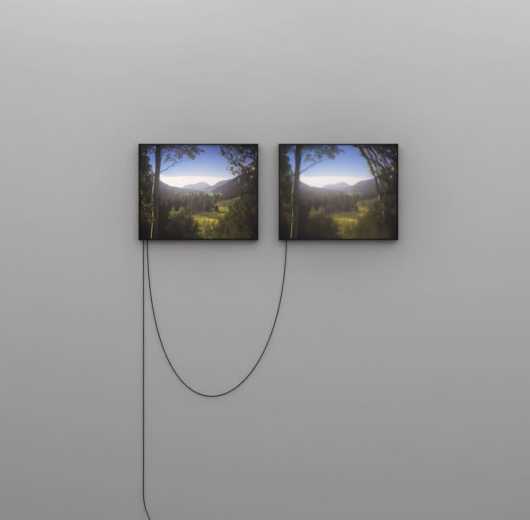
Double Bind is composed of two images. To the left, a photograph of the East River Valley of the Elk Mountains in Colorado looking towards Mount Crested Butte. An aspen frames the left edge, another’s leaves entering on the right, a meadow breaking into spruce forest, no road anywhere, remote and close to perfect. It is a crafted image, but not a composite, a lens was present. On the right, the viewer sees the left photograph’s reconstruction. An image steered algorithmically back out of the latent space that inverse diffusion process directed it to. Subtle differences come forth over time. On the right edge of the recreation, branches replace the dappled leaves of the aspens present in the left image, but upon closer examination, they aren’t branches at all but rather forms that give the suggestion of branches. The meadows leading into spruce forests have become soft and gestural, contours bleed into each other. Because the return from the latent space cannot land exactly where it began, the doubt begins to run in both directions. The recreation is not the only image that falls under suspicion. The old, already corroded assurance that a photograph is a window onto something that was really there fully deteriorates in its presence. Side by side, both images lose their footing.
Mark Dorf is a New York-based artist working across photography, video, digital media, and sculpture. Engaging collaboratively with ecologists and technologists, Dorf’s work questions perceptions of what Western culture often terms “nature.” His images and objects examine how design, image culture, technology, and science shape expectations of the “natural” world, while engaging deeply with the digital processes behind their production.
His work can be found in the collections of Deutsche Bank, Fidelity Investments, Foam Photography Museum, The Houston Center for Photography, and the RISD Museum, along with numerous private collections. Additionally, Dorf’s books are available in renowned libraries internationally, including Avery Library at Columbia University, Robert B. Haas Family Arts Library at Yale University, and The Thomas J. Watson Library at the Metropolitan Museum of Art.