RYAN LEE Gallery is pleased to announce traces, an exhibition of embroidery, installation, sculpture, video, and works on paper by Tiffany Chung. Chung’s recent projects explore earth’s deep times, Neolithic ditched and walled enclosures, and ancient global connections through the 3,500-year-old spice trade. Chung reorients the world through history, disentangling and reweaving the environmental, cultural, economic, and political threads that have created global narratives over millennia. Curator Orianna Cacchione has described Chung’s practice as an “insatiable search for knowledge itself.” Writing on Chung’s cartographic works, Cacchione explained, “The meticulously rendered infographics shuttle between legibility and illegibility, recognition and erasure, the poetic and the empirical, setting up a dialectical tension that is threaded throughout Chung’s works.”
Tiffany Chung: traces

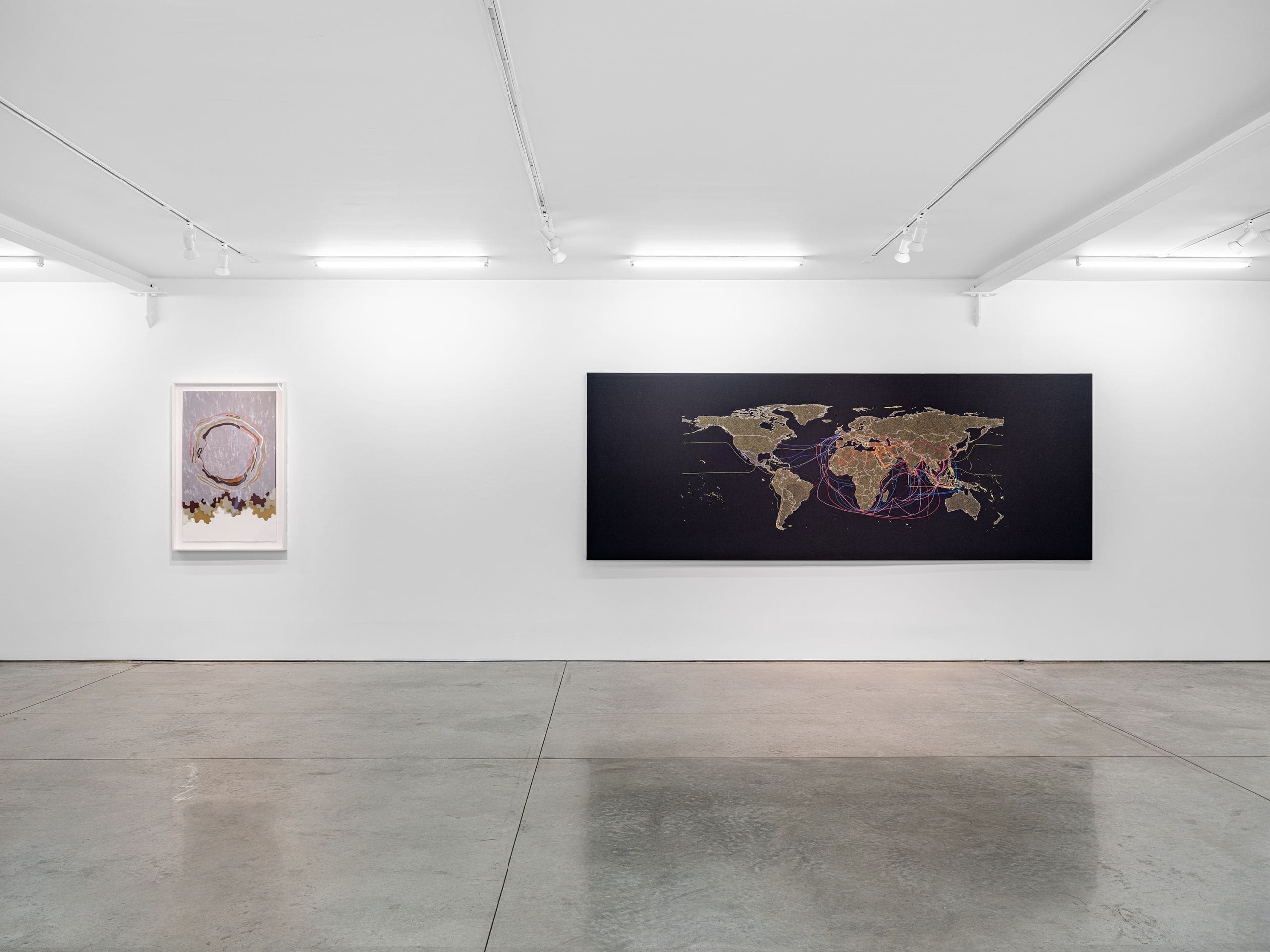
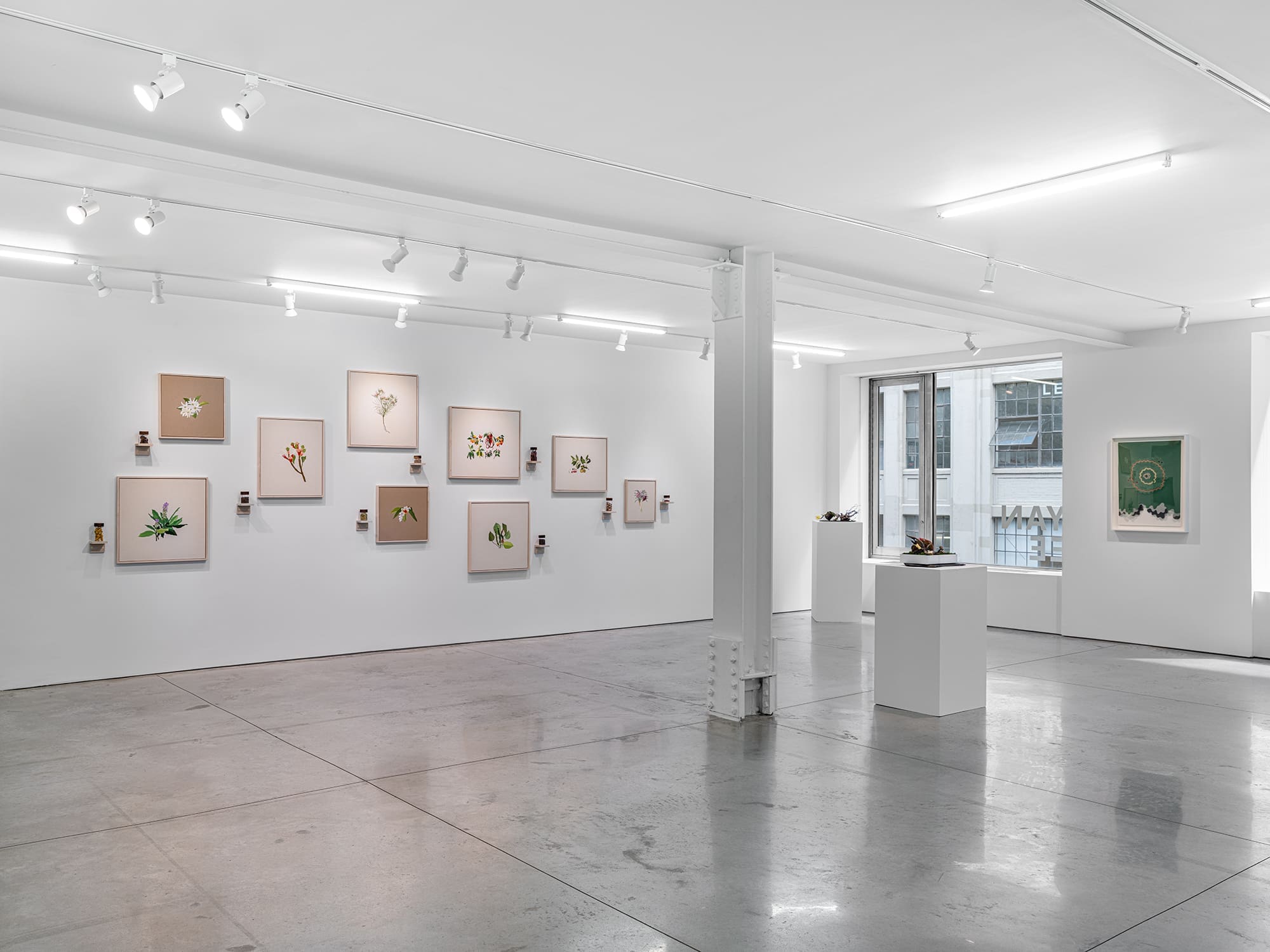

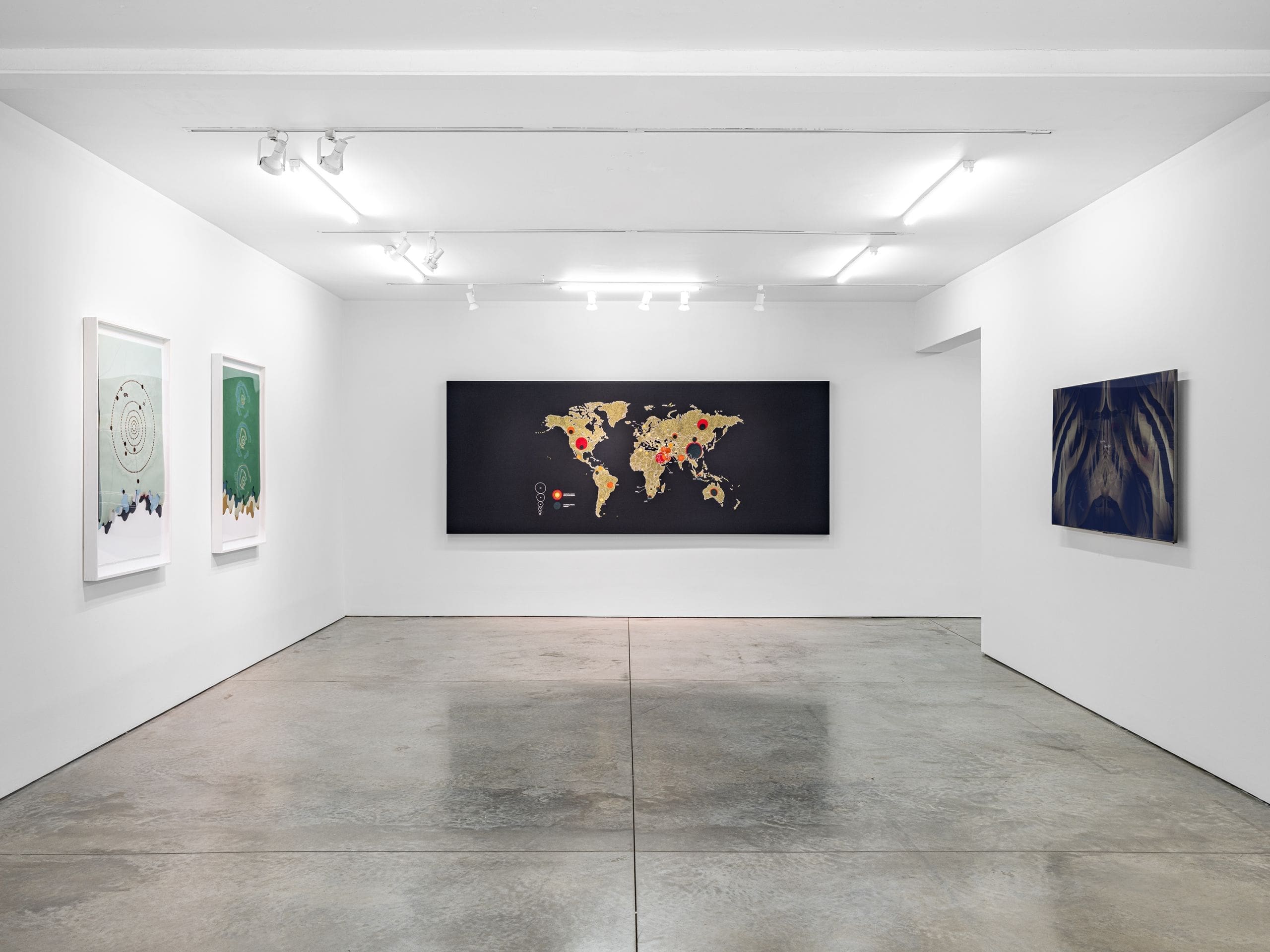
Chung’s conceptual framework is built upon two key pursuits. One is the multiplicity of history, challenging accepted narratives by filling in the gaps left out of official accounts, to shift and reclaim the discourse. The other is the entanglements of social, political, economic, and environmental processes across times and terrains, entwined in landscape archaeology and historical ecology – the intricate relationship between humans, the built environment, and the natural world.

Global Spice Trade: routes from ancient time to the age of exploration/exploitation
2024-25
Embroidery on fabric
Map: 55 1/8 x 149 5/8 inches (140 x 380 cm) Legend: 19 3/4 x 19 3/4 inches (50 x 50 cm)
Edition of 4

studies of exotic botanical organisms and spices from the ends of the earth in quest of market dominance
2025
Hand-embroidery on linen, spices in glass jars, handmade wooden shelves
Saffron: 17 1/8 x 15 1/4 inches (43.5 x 38.7 cm) Cardamom, Star Anise: 19 1/8 x 19 1/8 inches (48.6 x 48.6 cm) each Nutmeg, Clove: 25 1/4 x 21 1/4 inches (64.1 x 54 cm) each Peppercorn, Cumin, Turmeric: 25 1/4 x 25 1/4 inches (64.1 x 64.1 cm) each Chili Pepper: 25 1/4 x 29 1/4 inches (64.1 x 74.3 cm)
Edition of 3
In some of the work on view, Chung explores the movements of plants and spices through space and time, as they have been traded across the world from ancient times to today. In studies of exotic botanical organisms and spices from the ends of the earth in quest of market dominance (2025), Chung pairs embroidered illustrations of spice plants with jars displaying the spices themselves. The embroidered map Global Spice Trade: routes from ancient time to the age of exploration/exploitation (2024-25) casts an overview of the early global economic integration. Proposing that globalization began long before the 1400s, the work charts ancient spice trade routes connecting Asia, Africa, Europe, and the Americas. Chung says, “The spices’ trajectories across time and space link commerce, maritime development, conflict, and colonialism, which led to modern capitalism. They tell stories about how globalization began – through trade, migration, linguistic movements, culinary and cultural adaptation – and how it is inevitably intertwined with wars.”
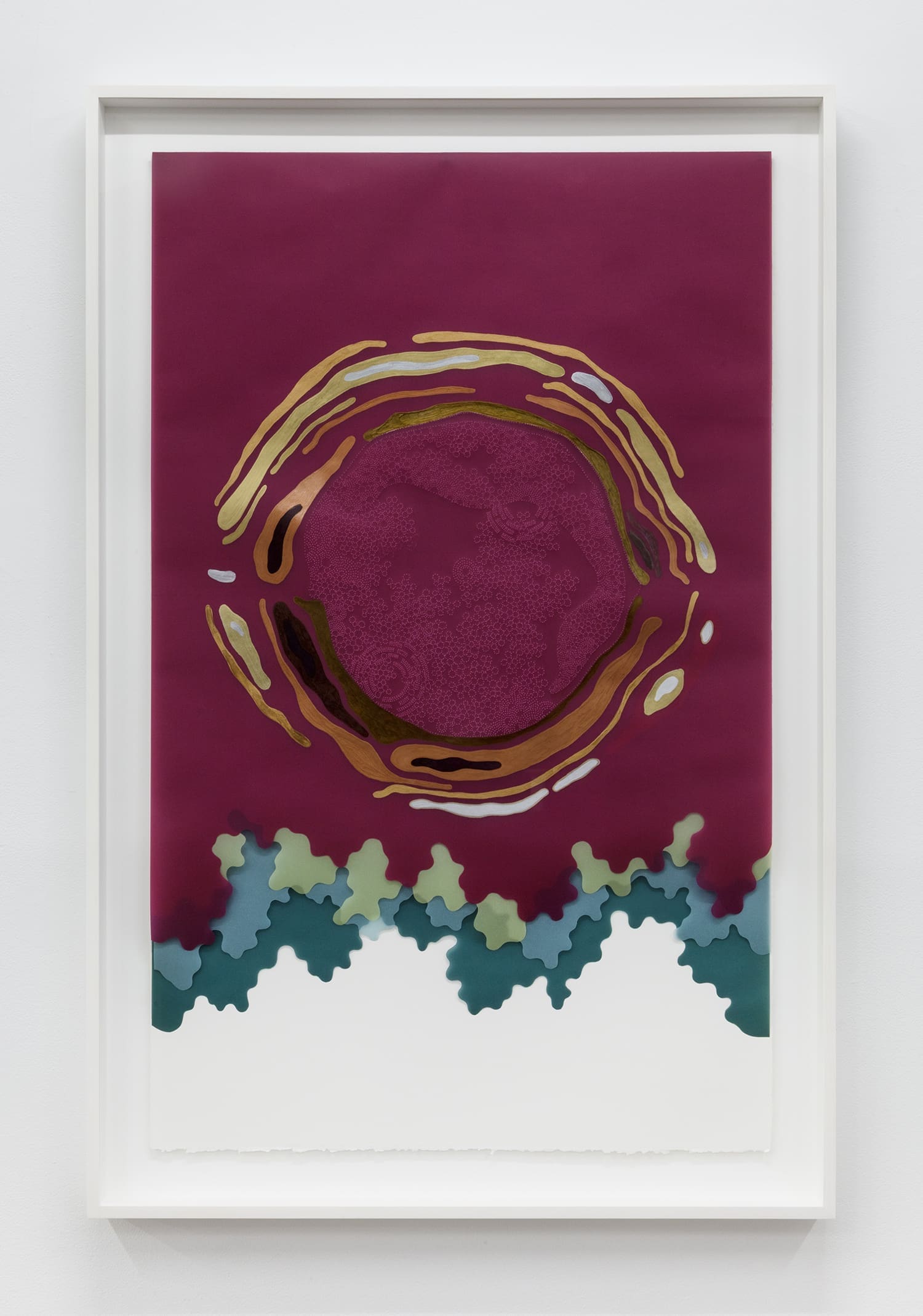
Terra Rouge CEW Study No.18
2025
Ink, oil, and hand perforating on vellum and paper
Paper Dimensions: 44 1/8 x 27 1/2 inches (112 x 70 cm) Framed Dimensions: 49 5/8 x 32 7/8 inches (126 x 83.5 cm)
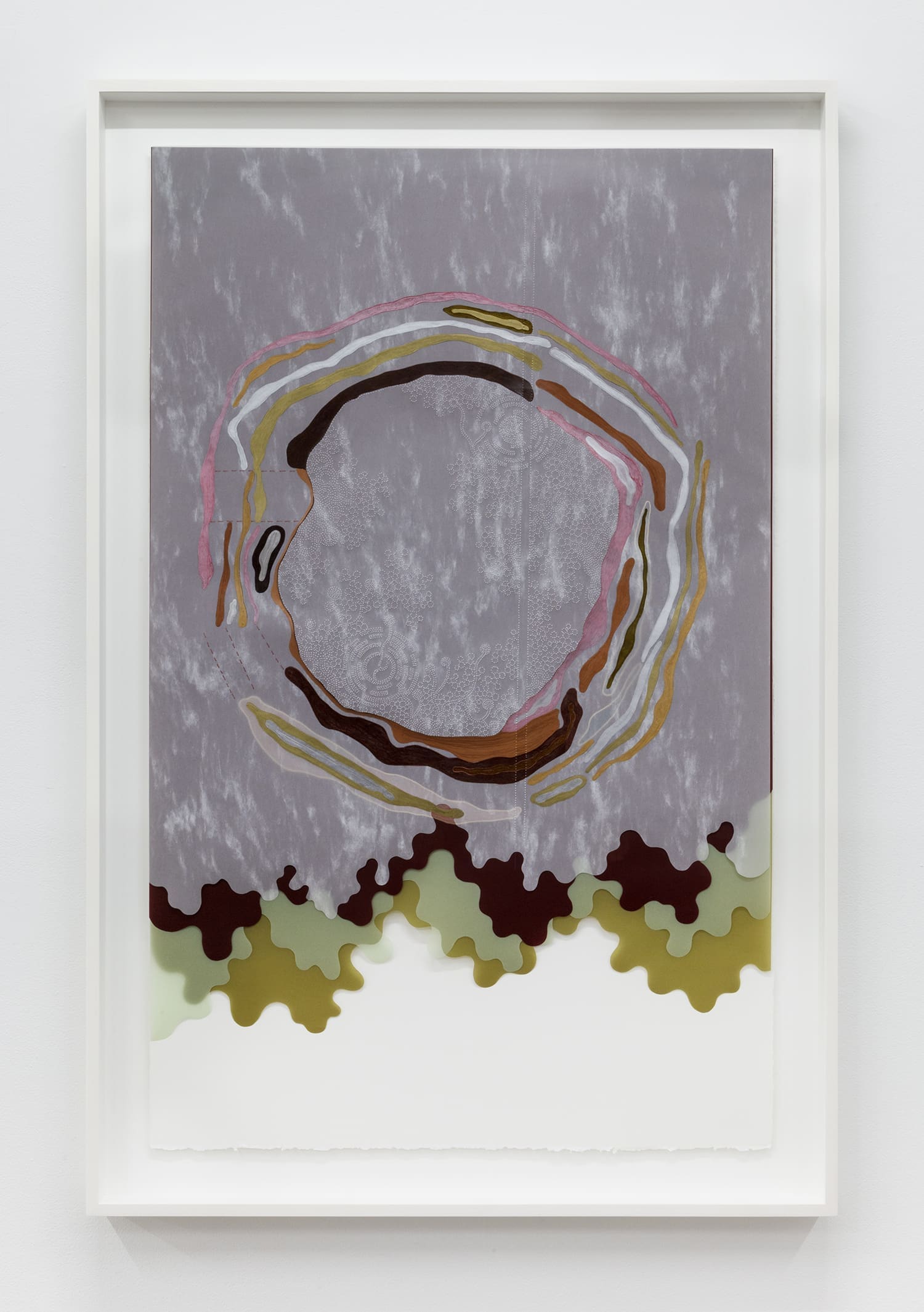
Terra Rouge CEW Study No.19
2025
Ink, oil, and hand perforating on vellum and paper
Paper Dimensions: 44 1/8 x 27 1/2 inches (112 x 70 cm)
Framed Dimensions: 49 5/8 x 32 7/8 inches (126 x 83.5 cm)
Chung’s works on paper depict traces of Neolithic ditched and walled enclosures dating from 5000 BCE found across Central Europe and the Iberian Peninsula, as well as Vietnam and Cambodia (2300-300 BCE). While suggesting possible prehistoric global connections, Chung notes how these traces of our material culture also indicate the human-driven alterations of landscapes, flora, and fauna throughout history. Such traces take another physical form in Chung’s latest project, the world through my mother’s cabinets of curiosities (cabinet no.2) (2026), with whimsical miniature sculptures created from discarded objects and materials donated to her by family and friends. As Chung seeks to bring new meanings to old objects embedded with personal history, these sculptures depict and reflect on human experience of disasters and survival, our impact on the environment, and the rebound and taking over by nature in the aftermath.
![Tiffany Chung Santa Vitória [Portugal], filling of Ditch 1: 2556-2040 BCE, Ditch 2: 2460-2200 BCE, 2026 Ink, oil, and hand perforating on vellum and paper Paper Dimensions: 40 1/2 x 25 1/4 inches (103 x 64 cm) Framed Dimensions: 45 3/4 x 30 3/8 inches (116.2 x 77.2 cm)](https://ryanleegallery.com/wp-content/uploads/2026/04/Tiffany-Chung-5.jpg)
Santa Vitória [Portugal], filling of Ditch 1: 2556-2040 BCE, Ditch 2: 2460-2200 BCE
2026
Ink, oil, and hand perforating on vellum and paper
Paper Dimensions: 40 1/2 x 25 1/4 inches (103 x 64 cm)
Framed Dimensions: 45 3/4 x 30 3/8 inches (116.2 x 77.2 cm)
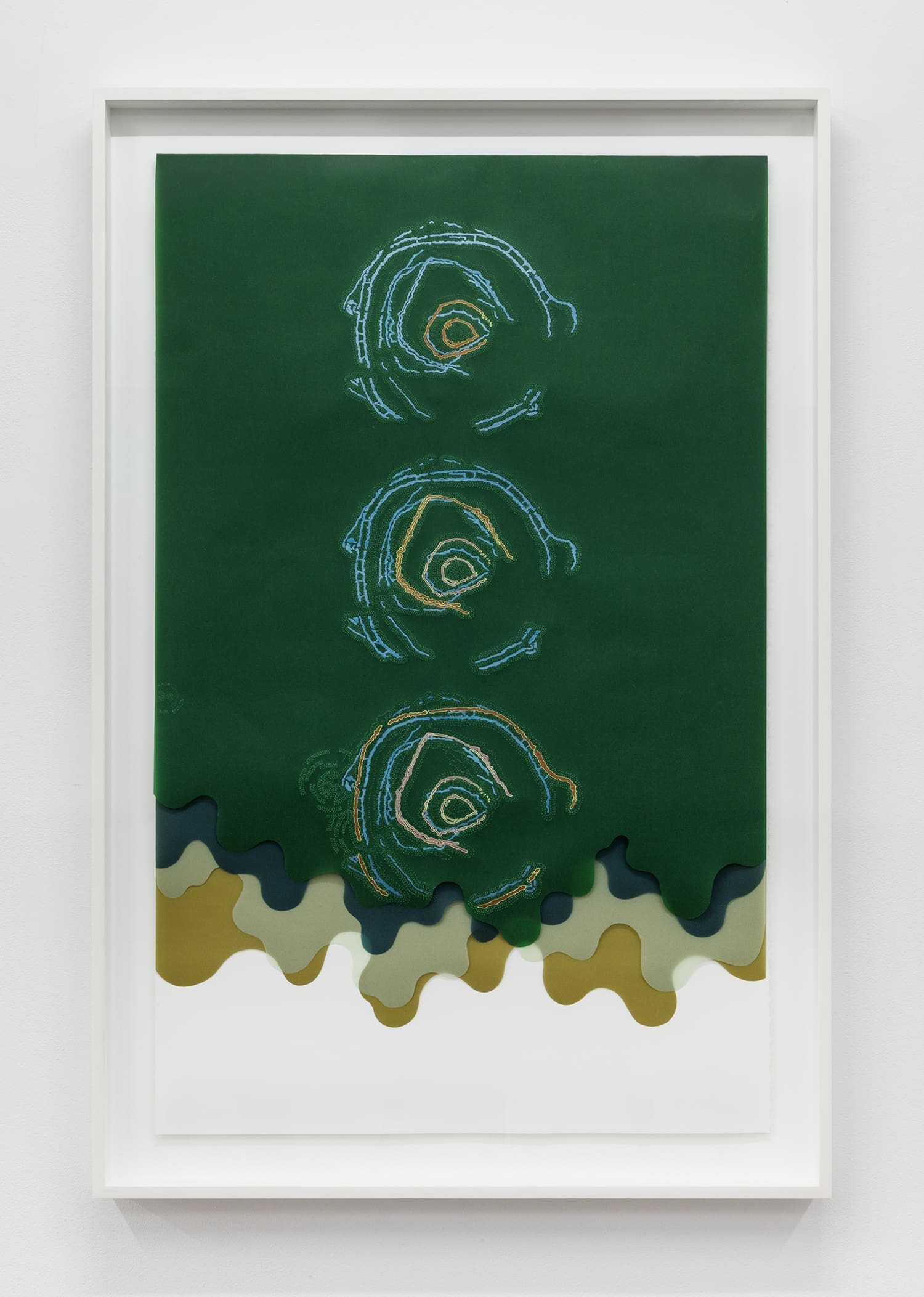
Perdigões [Portugal], filling: 3350-2900 BCE, 2900-2450 BCE, 2450-2150 BCE
2026
Ink, oil, and hand perforating on vellum and paper
Paper Dimensions: 44 1/8 x 27 1/2 inches (112 x 70 cm)
Framed Dimensions: 49 1/4 x 32 7/8 inches (125.1 x 83.5 cm)
Closing the loop with traces from earth’s deep time, Chung’s immersive 360° video, Spheres of Time (2026), was screened at UCSB’s AlloSphere research facility. The artist has reworked the video for RLWindow, viewable from the High Line at 26th Street. The video traverses across traces of different landscapes over stretches of geological and generational time. Contemplating earth’s deep time amid our social, political, economic and environmental processes, the work situates human civilizations as part of an expansive natural history. traces as a whole reminds us that the imprints of our past are carried into the future, and that we are responsible for the care of creation and sustainable ecology, beyond human history.
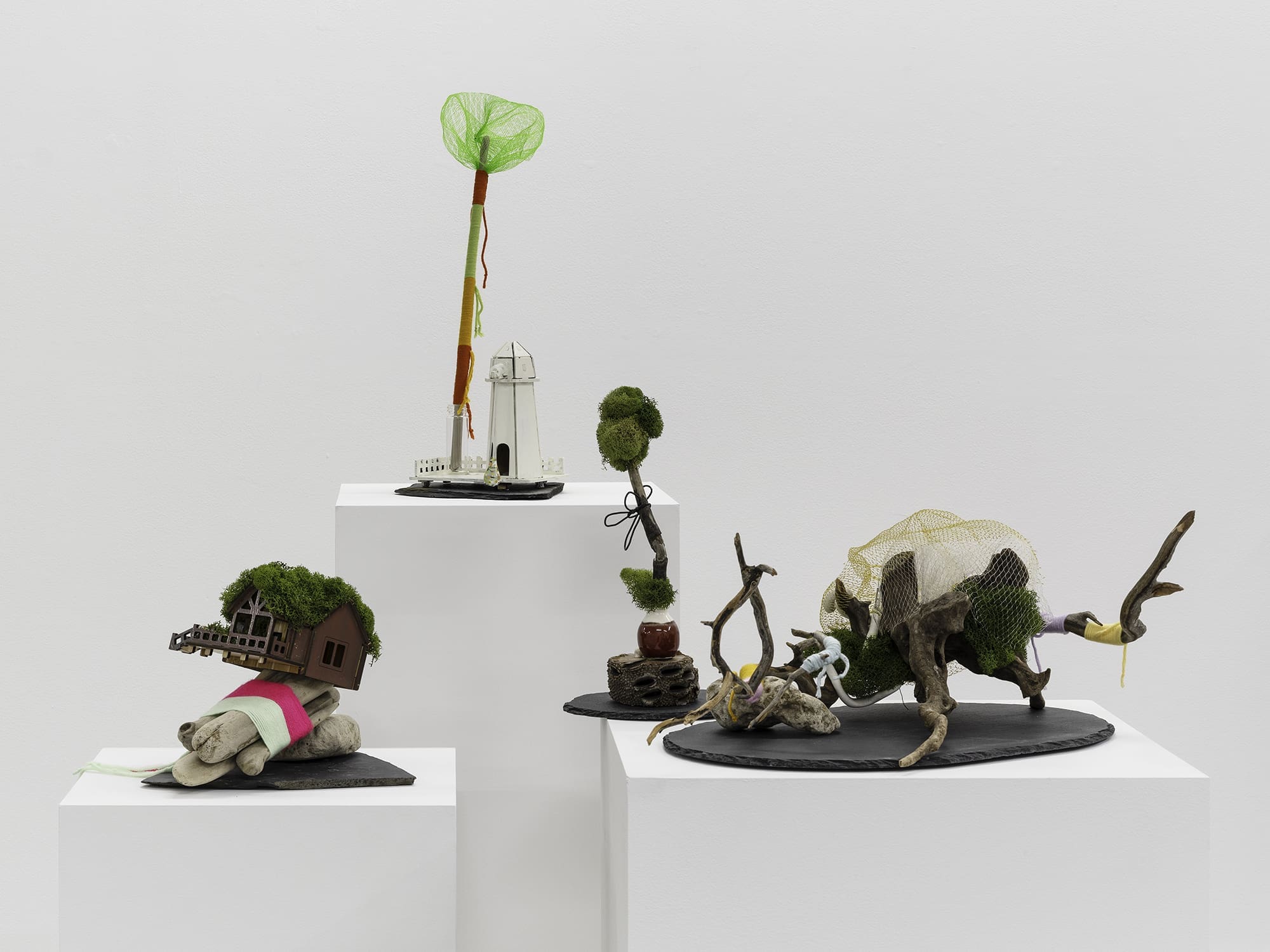
the world through my mother’s cabinets of curiosities (cabinet no.2)
2026
Repurposed materials, discarded objects, acrylic paint
Dimensions Variable

the world through my mother’s cabinets of curiosities (cabinet no.2)
2026
Repurposed materials, discarded objects, acrylic paint
Dimensions Variable

the world through my mother’s cabinets of curiosities (cabinet no.2), c.2-05
2026
Repurposed materials, discarded objects, acrylic paint
7 1/2 x 13 1/2 x 11 1/2 inches (19.1 x 34.3 x 29.2 cm)
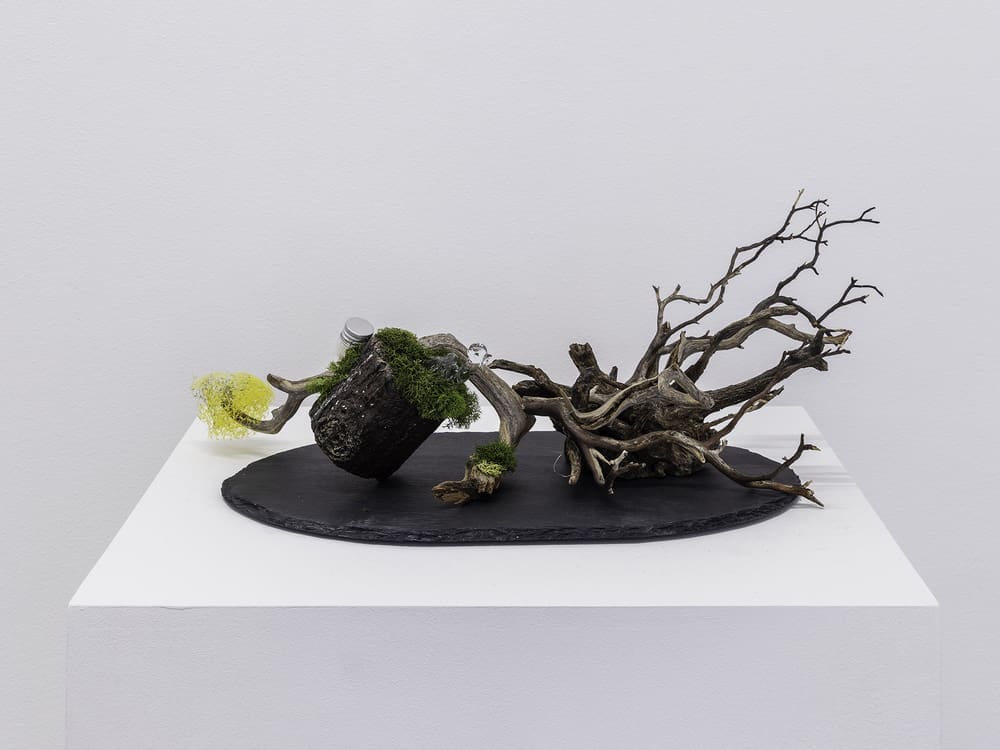
the world through my mother’s cabinets of curiosities (cabinet no.2), c.2-07
2026
Repurposed materials, discarded objects, acrylic paint
Left component: 5 x 11 x 4 1/4 inches (12.7 x 27.9 x 10.8 cm) Right component: 9 x 11 x 8 inches (22.9 x 27.9 x 20.3 cm) 10 x 21 x 8 inches (25.4 x 53.3 x 20.3 cm) overall
Tiffany Chung (b. 1969 Da Nang, Vietnam) is globally noted for her interdisciplinary practice cultivated through rigorous analysis of the history, culture and topography of different locales. Based on painstaking research, Chung’s work perceptively visualizes the entangled effects of geopolitical change on people and nature. Entwined in threads of landscape archaeology and historical ecology, Chung uses cultural memories and lived experiences to weave interventions into the narrative produced through statecraft. Chung explores the interconnected layers of history that create globalized networks, from the ancient spice trade to present-day patterns of migration to the future impacts of climate change.

USM Global: tracing the US military global footprint
2023
Embroidery on fabric
Map: 55 1/8 x 117 3/8 inches (140 x 298 cm) Legend: 15 3/4 x 27 1/2 inches (40 x 70 cm)
Unique variant
A comprehensive museum survey of Chung’s work, indelible traces, opened at the Art, Design & Architecture Museum at University of California, Santa Barbara in January 2026 and will travel to the Weisman Art Museum at the University of Minnesota and the Blaffer Art Museum at the University of Houston. An exhibition catalog with contributions by curators Orianna Cacchione and Sarah Newman accompanies the show.
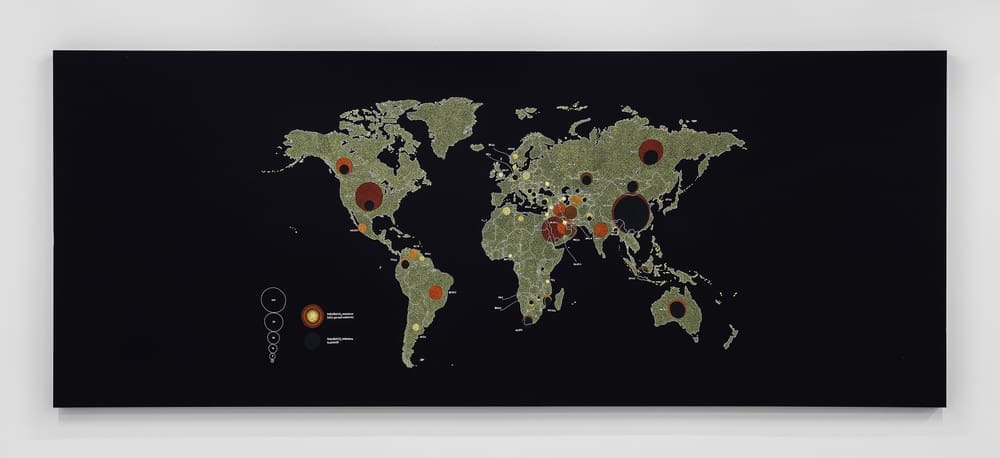
Energy Policy vol.166: potential CO2 emissions until 2050 by key fossil fuel and coal extraction projects [each>1 Gt] worldwide
2023
Embroidery on fabric
55 1/8 x 137 7/8 inches (140 x 350 cm)
Edition of 3
Her work has been included in solo and group exhibitions at the Haus der Kulturen der Welt, Germany (2026); Nevada Museum of Art, NV (2026); Sun Valley Museum of Art, ID (2025); Hammer Museum, CA (2024/2025); 21st Century Museum of Contemporary Art Kanazawa, Japan (2024), Kaohsiung Museum of Fine Arts, Taiwan (2024); Moody Center for the Arts at Rice University, TX (2024); Museum of Contemporary Art, Busan, South Korea (2024); Museum Van Loon, the Netherlands (2024); Dallas Museum of Art, TX (2023-2025); the British Museum, United Kingdom (2023); Smithsonian American Art Museum, DC (2023), the National Mall, DC (2023) Buffalo AKG Museum, NY (2023); Deichtorhallen Hamburg, Germany (2023); M+, Hong Kong (2023); among others. Biennales include Diriyah Contemporary Art Biennale, Saudi Arabia (2024); Bangkok Art Biennale (2022); Biennale of Sydney (2018); Gwangju Biennale (2018); EVA International–Ireland’s Biennial, Limerick (2016); Venice Biennale (2015); Shajar Biennale (2013); among others.

Marroquíes Bajos [Spain], filling: 2510-2310 to 2115-1795 BCE
2026
Ink, oil, and hand perforating on vellum and paper
Paper Dimensions: 44 1/8 x 27 1/2 inches (112 x 70 cm)
Framed Dimensions: 49 5/8 x 32 7/8 inches (126 x 83.5 cm)

Xancra [Portugal], 3rd millennium BCE
2026
Ink, oil, and hand perforating on vellum and paper
Paper Dimensions: 30 3/4 x 22 1/4 inches (78 x 56.5 cm)
Framed Dimensions: 33 7/8 x 26 3/8 inches (86 x 67 cm)
Her work is held in the collections of 21st Century Museum of Contemporary Art Kanazawa, Japan; AK Wien Kultur, Austria; the British Museum, UK; Dallas Museum of Art, TX; Faurschou Foundation, Denmark; The Ford Foundation, NY; Fukuoka Asian Art Museum, Japan; Herbert F. Johnson Art Museum, Cornell University, NY; Louisiana Museum of Modern Art, Denmark; M+, Hong Kong; Minneapolis Institute of Art, MN; Orange County Museum of Art, CA; Queensland Art Gallery, Australia; San Francisco Museum of Modern Art, CA; Sharjah Art Foundation, United Arab Emirates; Singapore Art Museum, Singapore; and Smithsonian American Art Museum, DC; among others.


