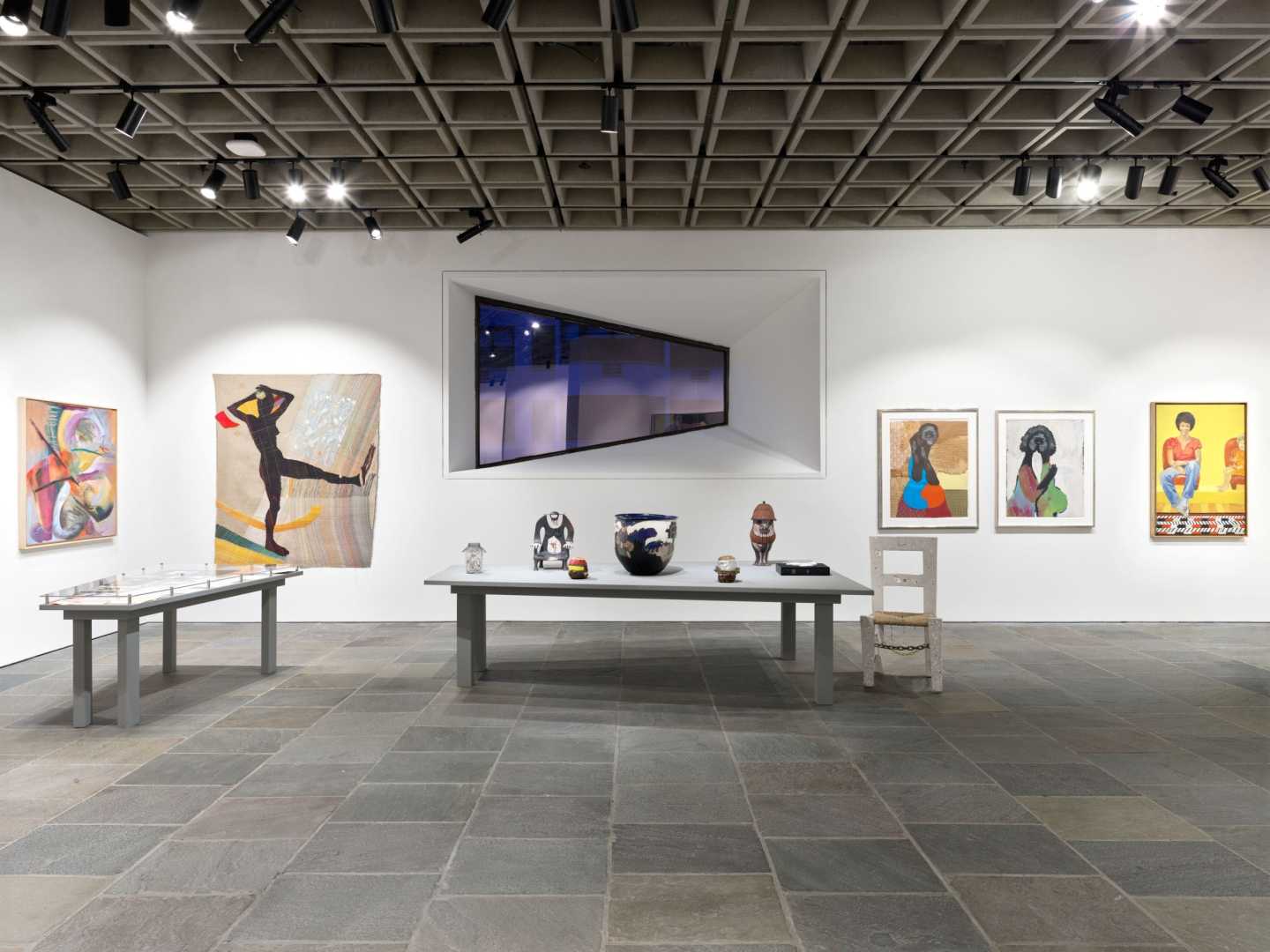
RYAN LEE Gallery and Salon 94 announce Black SoHo, a presentation of paintings, sculptures, and works on paper made between 1961 and 1984, staged in the historic Breuer building — former home to the Whitney Museum of American Art. The booth brings together major works by Emma Amos, Jean-Michel Basquiat, Camille Billops, Frederick J. Brown, Vivian Browne, Ed Clark, David Hammons, and Norman Lewis: artists who built a life and a language in SoHo decades before the neighborhood’s story was written, a history that left many of them out. Explore our online publication here.
The story we present is not one of a scene these artists joined, but rather one they built together: between the 1960s and late 1980s, more than twenty-five Black artists lived and worked in SoHo and its adjacent neighborhoods, converting raw manufacturing spaces into studios, stages, and salons. The loft—vast, unregulated, full of potential—was medium as much as workspace: it held the work and made it possible. Taken together, Black SoHo describes the people and place but also a framework for a lived practice.
Camille Billops and James Hatch’s loft at 491 Broadway, acquired in 1975, was a hub for artists, writers, and activists across race, generation, and discipline. “The loft represents being an artist,” Billops said. Exhibitions, artist talks, readings, political gatherings all happened there, alongside the oral histories she and Hatch recorded and published for thirty years in their journal Artist and Influence: The Journal of Black American Cultural History, a consummate record that no one else was keeping. Billops, interviewed by bell hooks in 1996, said, “I always tell people the most revolutionary thing you can do is do a book about your life…put all your friends in it, everybody you loved, and do a lot of them so one day they will find you and know you were all here together.”
A few blocks away, Ornette Coleman ran Artist House out of his loft at 131 Prince Street, folding music and visual art into a single practice. Billops showed there in 1973; Vivian Browne in 1974 — first solo exhibitions for both, at a moment when the city’s mainstream galleries offered few opportunities. Frederick J. Brown’s 120 Wooster Street loft, founded in 1972, ran with the same logic at a larger scale: a 5,000-square-foot laboratory where painting met music, poetry, and dance, and where collaborators from Anthony Braxton to Felipe Luciano performed.
Vivian Browne bought her loft in 1968, following Norman Lewis, who had settled on Grand Street the year before. Emma Amos arrived on King Street in 1969. Ed Clark and David Hammons moved through the neighborhood, bringing their contributions through SoHo: Clark showing at Donald Judd’s Spring Street loft in 1971 was one of the era’s rare crossings between Black SoHo and its more familiar counterpart; Hammons worked from Harlem but staying in constant, transient contact with the downtown scene. Basquiat, arriving in 1981, inherited a flourishing ecosystem that had already been built.
Several of these artists were active in the Black Emergency Cultural Coalition, which picketed the Whitney in 1971 demanding the inclusion of Black artists in its exhibitions. Their work now hangs together inside the same building — not as correction, but as continuation in the spirit of perseverance.
Also on view is a set of furniture commissioned from contemporary chairmaker Robell Awake, whose practice treats craft objects as vessels for cultural memory. Awake’s chairs, which use oyster shells to make tabby concrete, are made in concert with the works in the booth, extending the loft’s logic into the present — the idea that a functional object can also be an act of community and resistance.


