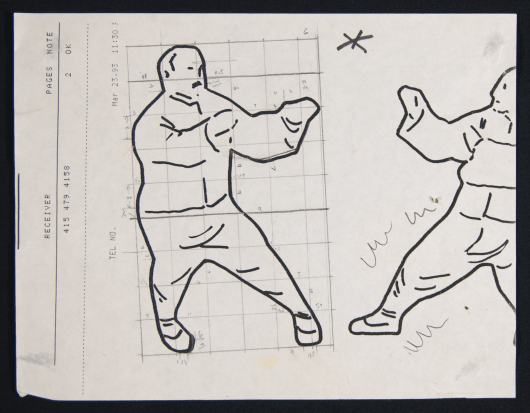
In the early 1990s Hung Liu began shaping her canvases according to the subjects she was painting. Since her paintings were based on historical Chinese photographs, she selected human figures and their adjacent spaces from within the photographs and crafted her canvases to conform with the organic curves of her subjects and the odd angles hugging their outlines. The images in the photographs – say, a posing Chinese sex worker, a self-portrait, or a pair of squared-off Tai Chi martial artists – would figure forth as objects while the wall receded into ground, allowing the image to seemingly “pop” off the wall (at the time, this was Liu’s sense of Pop Art). Sometimes, these shaped canvases would press against the geometric limits of the gallery spaces containing them, allowing each painting to seem larger as an image than it was as an object.


Why shaped canvases? In China, Liu had been educated at the prestigious Central Academy of Fine Art (CAFA) in Beijing. Though trained there as a muralist, the edges, boundaries, surfaces, colors, and subjects then permitted were limiting and conventional. Unlike the western avant-garde, the purpose of art in China was to reinforce, not challenge, artistic and political conventions. Indeed, in 1978 the academy’s painting curriculum was subdivided into Chinese Painting and Oil Painting, each a separate department. At the same time, as a gesture toward a hoped-for influx of western tourists in the wake of the Cultural Revolution and the emerging open-door policy, CAFA initiated a small mural program of which there were two students, one of whom was Liu. The idea was that murals would turn outward towards the world (in airports, for example) instead of inward upon the people. This seemed less naïve in an era before mass communications since walls and buildings had long been the surfaces of Chinese public rhetoric. An infamous Beijing airport mural by Yuan Yunsheng, head of the CAFA mural program, depicting a water festival intended to welcome tourists upon arrival, was swiftly concealed by a curtain because it featured several nude or semi-nude figures. Liu’s own mural at CAFA, completed as her graduate project in 1979, was painted on a fifty-foot wall of the “Foreign Student’s Dining Hall,” although most Chinese students ate there too. As CAFA art critic and curator Hou Hanru once said to Liu, “We all grew up eating under your mural.” As Yuan Yunsheng also told her, “Your mural will live and die with the architecture.” Just so, in the late 1990s CAFA was torn down and a new campus rebuilt in the Chaoyang District, and Liu’s mural, Music of the Great Earth, which had fallen into decline since the 80s, was destroyed.

Music of the Great Earth was an ambitious mural measuring fifty feet in length and ten feet in height, and it held a commanding presence within the cultural landscape of early 1980s Beijing [1]. Artist Yu Hong—who would later follow Liu as a student at the Central Academy of Fine Arts (CAFA)—recalled the work in 2021: “When I was studying at the Central Academy of Fine Arts in Beijing in 1984, the new students’ dormitory had just sprung up. The landmark twelve-story building was a skyscraper in my eyes. The largest space on the first floor was the faculty dining hall, which featured a large-scale mural. Mysterious, grayish-green hues; splendid gilded embossments; elegant, historical chime bells; and scenes of music—this full-fledged display of what was then a highly fashionable style of ethnic decoration was Hung Liu’s mural Music of the Great Earth. In the early 1980s, China had just introduced reforms and opening-up policies, and it became stylish to commission large murals for new buildings.” [2]
As Yu Hong’s recollection suggests, Music of the Great Earth stood as both an aesthetic and ideological landmark within the shifting visual culture of reform-era China. Created at a moment when state-sponsored art sought to modernize while retaining a sense of national identity, the mural exemplified Liu’s ability to merge socialist realist training with an emergent decorative sensibility rooted in historical Chinese motifs. For the younger generation of artists who came of age under its gaze—including Yu Hong and Liu Xiaodong—the work was more than a backdrop to daily life; it symbolized artistic ambition within a rapidly transforming society. Revered as a figure who had skillfully negotiated the constraints of official art production before establishing a new career in the United States, Liu embodied a model of perseverance and cross-cultural adaptation that continued to resonate long after Music of the Great Earth faded from view.
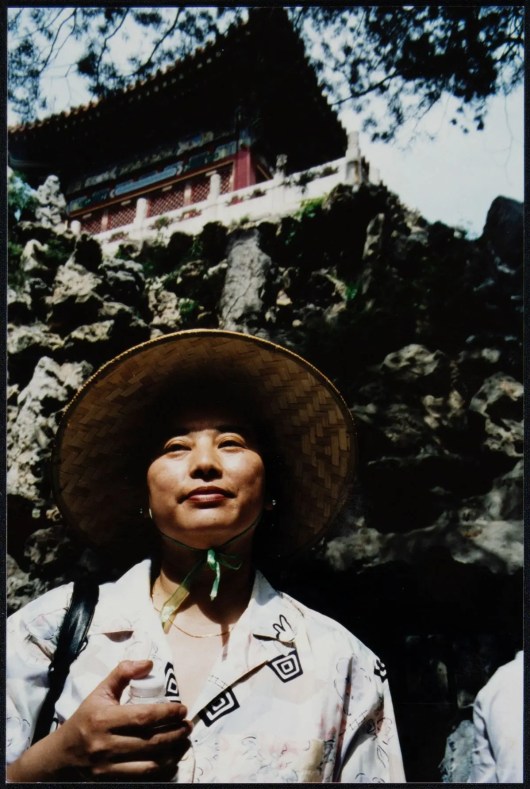
After emigrating to the United States in 1984, Liu’s work began to engage her homeland from a reflective distance. As a student of Allan Kaprow at the University of California, San Diego, she absorbed the ethos of Happenings and participatory art, expanding her practice beyond traditional painting into spatial and performative contexts. Throughout the 1980s, Liu exhibited works that actively disrupted the conventional boundaries of exhibition space using charged objects—piles of fortune cookies, carved wooden tai-chi figures, fragments of poetry written in Chinese characters across architectural elements, a triptych of large-scale charcoal sketches on canvas based on studio photographs and contemporary snapshots of the prominent San Francisco Wong family, and a monumental self-portrait rendered as an oversized government identification card foregrounding the bureaucratic, and derogatory label “Resident Alien.” As artist Liu Xiaodong observed, it was “a self-portrait that protests identity,” a statement that encapsulates the work’s critical interrogation of displacement and belonging [3].
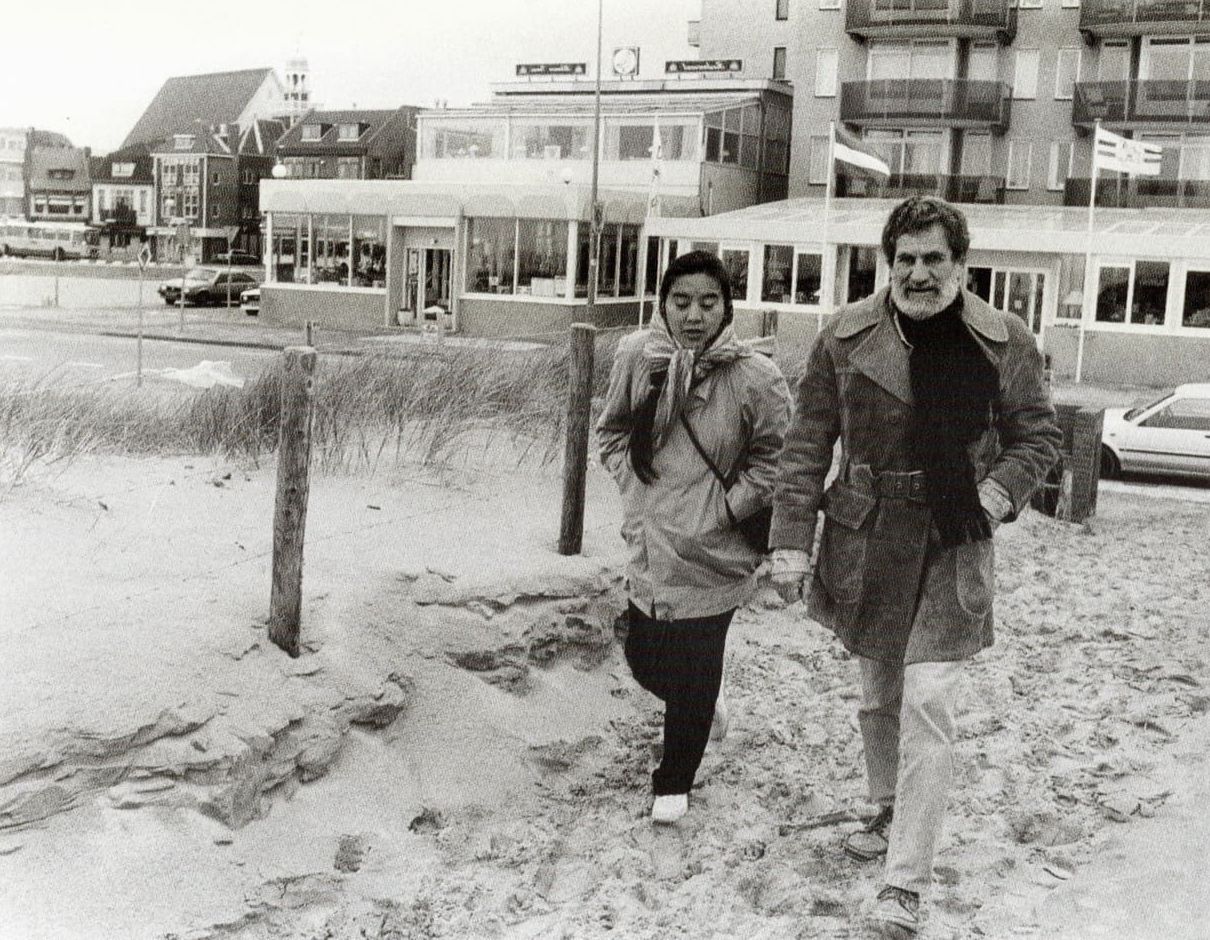
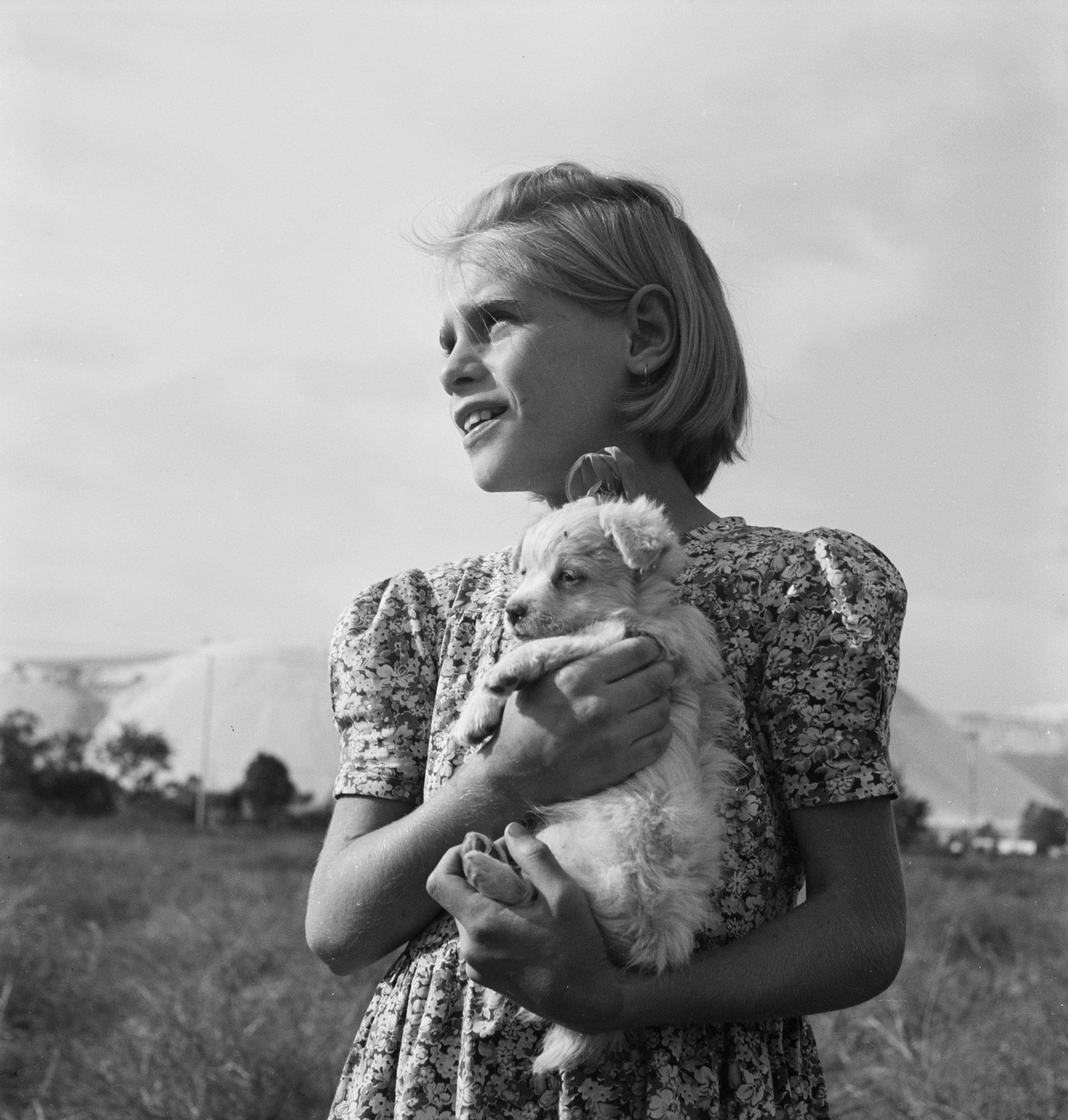
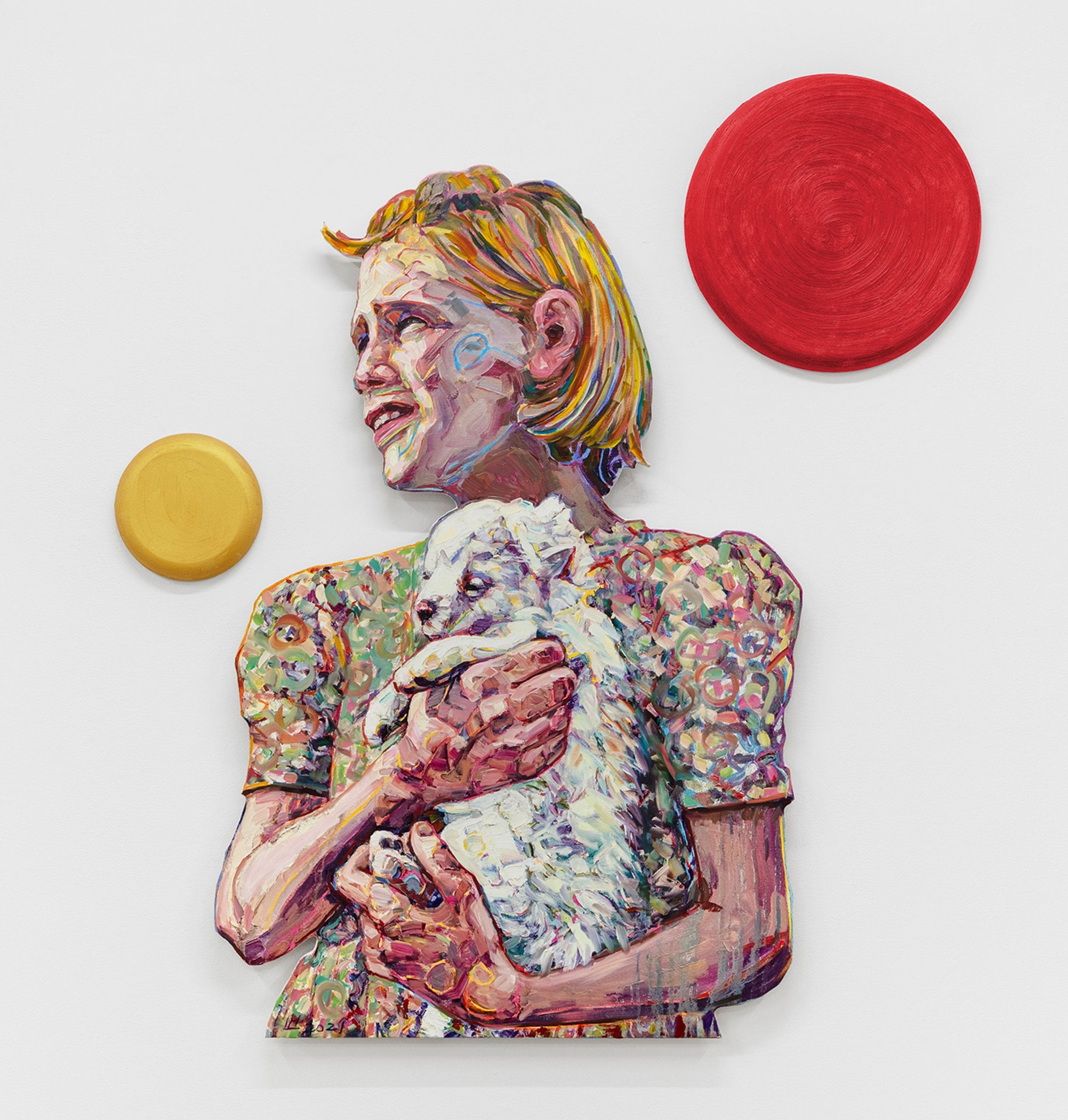
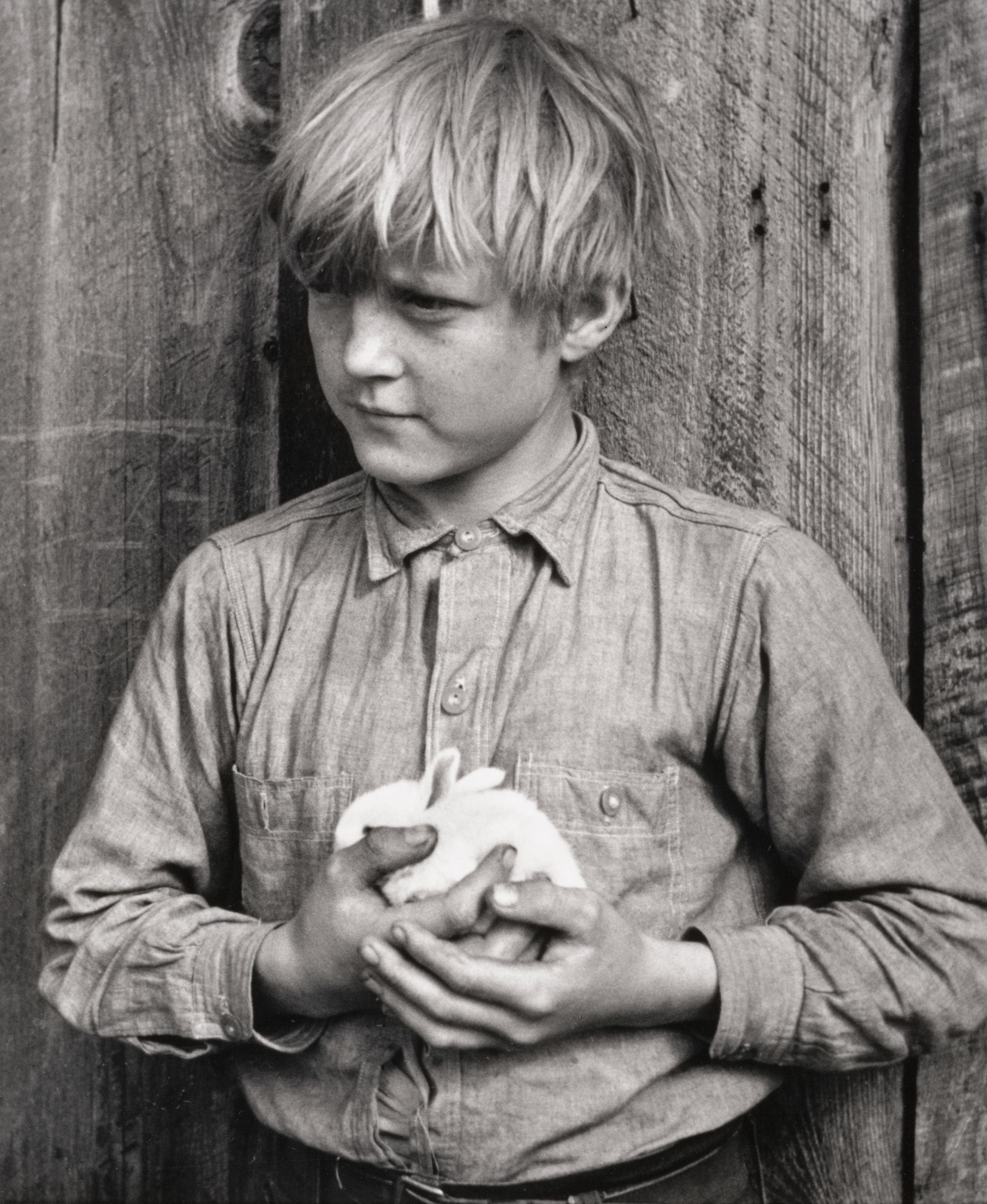
Liu’s experimentation with form and expansive spaces, using often monumentally-scaled canvases emulating the scale of murals, continued into the 1990s with a series of shaped canvases that asserted their physical and conceptual presence by defying both frame and category. These hybrid works project forcefully into the viewer’s space, existing simultaneously as painting and sculpture. In their refusal of containment—material, spatial, and cultural—they exemplify Liu’s persistent effort to outmaneuver artistic and ideological boundaries, transforming the conditions of displacement into a generative site for innovation. In her final years, Liu revisited her exploration of shaped canvases through what she described as “ensemble paintings.” In these works, images of migrant workers and children—figures that recalled her own experiences laboring in the countryside during proletarian reeducation—were drawn mainly from the work of Depression-era photographer Dorothea Lange, as well as other documentary photographers such as Constance Stuart Larabee and Horace Bristol. These archival images were projected and shaped on wood and aluminum, then painted and reconfigured into new, layered compositions.

Liu’s impulse to produce hybrid works that playfully defy categorization also surfaces in her inventive printmaking techniques. A recipient of a lifetime achievement award in printmaking, Liu experimented extensively by recycling imagery from her own paintings into new media, including resin-based works. Each piece begins with painted or photographic images digitally printed onto prepared wooden surfaces, sealed in resin, and then hand-painted by the artist using various colors of printer’s ink. Through this process, layers of mechanical reproduction are transformed by the artist’s hand into singular works. They are not prints, but paintings by other means—hybrids that unite printmaking techniques with the act of painting. These works, in a sense, operate as a form of time-based media: a form of lenticular printing, their layered resin and gold leaf surfaces animate and refract light, shifting with the viewer’s perspective.
Liu’s ongoing exploration of material hybridity and surface transformation extends into her paper pulp paintings, works created by applying pigmented liquid pulp onto a wet pulp support and running it through a press. In this medium, Liu continues to investigate the tactile and symbolic potential of her materials. Many of these works incorporate ancient Chinese symbols drawn from her archival research into classical calligraphy and visual traditions, as well as from her documentation of artisans encountered during her period of rustication for proletarian reeducation. Through the physicality of the pulp surface, Liu reanimates these historical references, bringing them into dialogue with the immediacy and texture of her own lived experience.

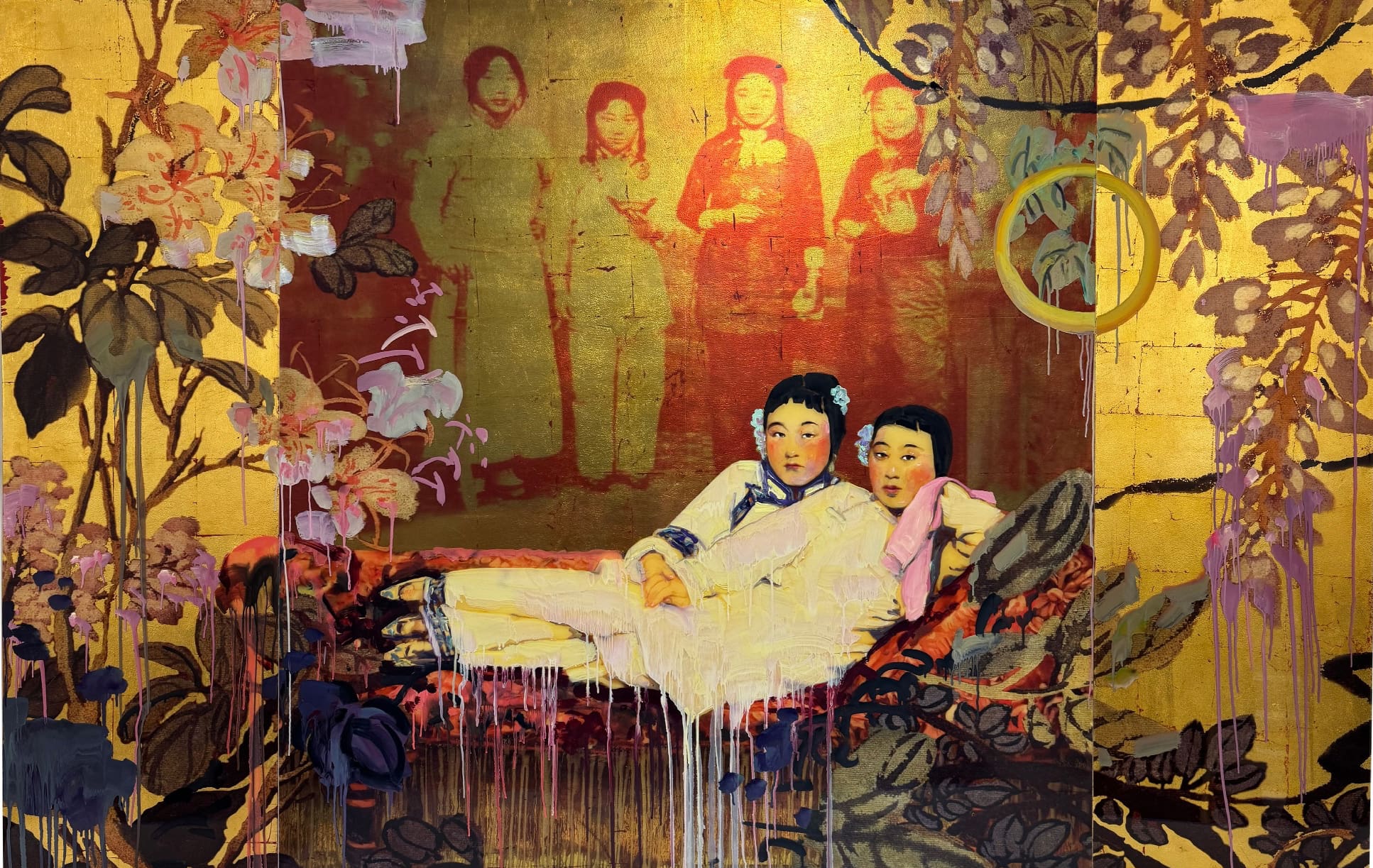
In Women Vessel (1993), Liu expands upon a conceptual thread first articulated in a 1990 group exhibition Vessel at D-Art, a local Arts Center in Dallas. That body of work established the metaphor of the “vessel” as both a formal and cultural construct, one deeply entwined with histories of gender, materiality, and power. In the artist’s statement for the exhibition, Liu wrote: “Just as the Chinese have shaped vessels of clay, bronze, jade, ivory, porcelain, gold, and silver, so too have they molded their women into decorative, fragile, and sophisticated objects. Perhaps because they feared their inner powers, Chinese men have traditionally blamed women for social ills and reshaped them through foot-binding and breast-flattening into objects of outward beauty and inward obedience. … I am of a newer generation, one that is trying to excavate and open ancient vessels in the belief that their contents are worth recovering—and worth recovering from.” [4]

Building upon these ideas, Women Vessel extends Liu’s inquiry into the intertwined processes of cultural inheritance and personal transformation. Through acts of shaping, pouring, and layering, she re-engages the notion of the vessel as both container and body—an object that bears history while also enacting renewal. Her experimental manipulation of materials reflects a dialogue between restraint and release, precision and improvisation, echoing the tensions articulated in her earlier writings.
In this way, Liu not only reclaims Chinese historical artifacts, archival photographs, and symbols as sites of agency but also defines her own position within her newfound artistic freedom in the United States, an experience she described in a 2008 interview with sculptor Sui Jianguo on a return trip to Beijing,
 When I arrived in America, I had to redefine myself; redefining my relation with China, with America and with myself. . .I’m journeying forward with my past carried on my shoulders.” [5]
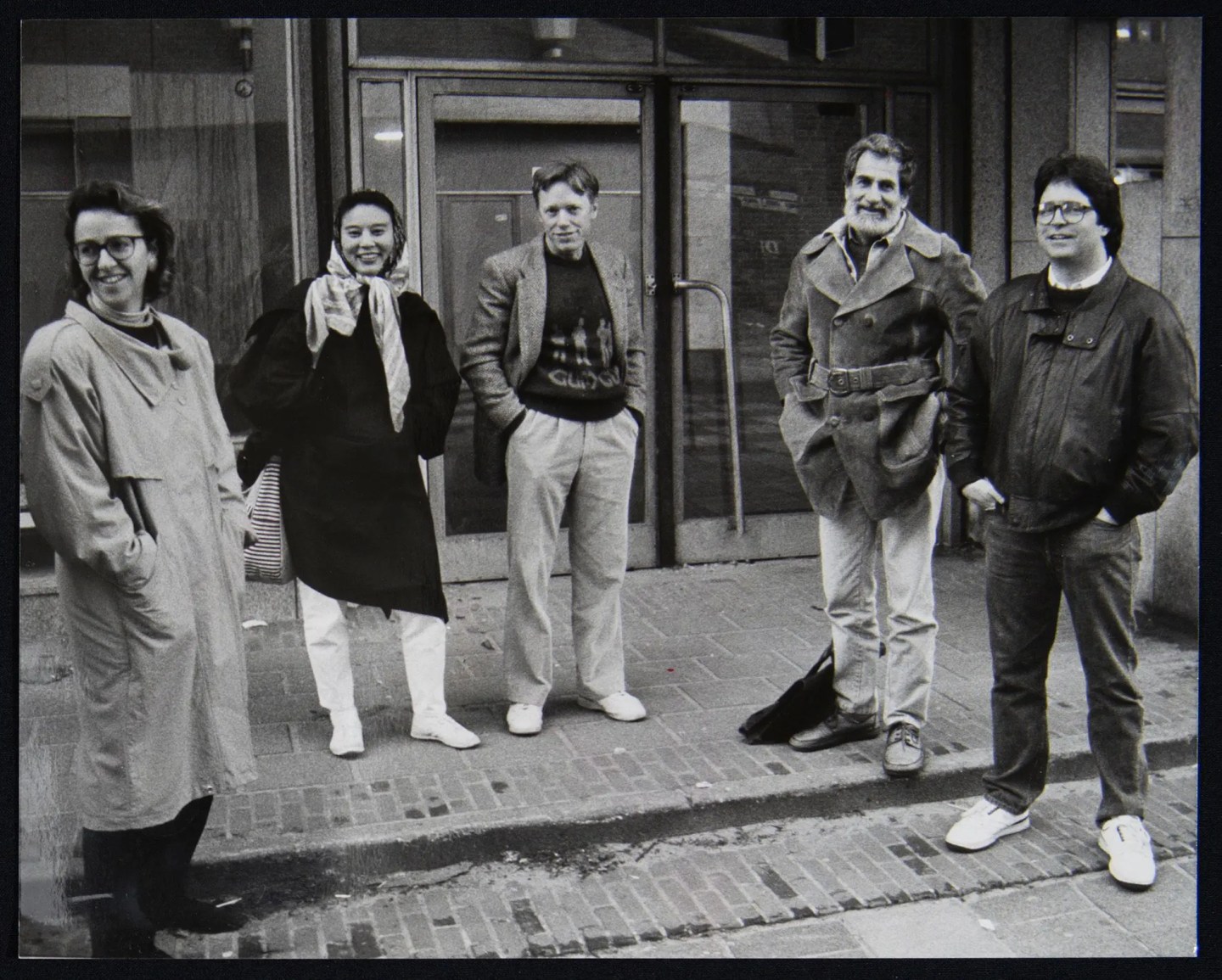
Essay by Jeff Kelley and Dorothy Moss
[1] This is the final sentence that Jeff Kelley wrote. The remainder of the essay was completed by Dorothy Moss.
[2] Yu Hong, Hung Liu, Portraits of Promised Lands, National Portrait Gallery, Smithsonian, 2021, page 175.
[3] Liu Xiaodong, “Artist Reflection,” Hung Liu, Portraits of Promised Lands, National Portrait Gallery, 2021, p. 180). The objects mentioned were first displayed together in 1988 at Hung Liu’s Capp Street Residency exhibition, Resident Alien, installed in the Monadnock Building as the culmination of her research into the history of Chinese immigration to California.
[4] Hung Liu, artist statement, “Vessel,” for the exhibition “The Vessel,” D-Art, Dallas, Texas, 1990; Hung Liu Estate Archives.
[5] Hung Liu, interview with Sui Jianguo, sculptor and dean of the sculpture department at the Central Academy of Fine Arts, Beijing, 2008; Hung Liu Estate Archives.


